

How to build it from scratch and how the process as much as the outcome can help you better operate your family office
Maybe you are in the process of starting your own family office from scratch? Or maybe you did it already, in a progressive way, gathering information here and there, and trying to organize it all to operate the FO?
Whatever your situation is, you will be facing the question of file classification (paper or digital) soon or later.

Why is it important?
Effective business operations requires fast, easy and secured access to relevant information and documented evidence.
Here comes your friendly reminder that a family office is a business. In order to achieve the family’s objectives in an efficient way, we need to professionalize our practices.
- Safety first
The first purpose of doing so, is to maintain a high level of security.
Losing a document, giving an old version, sending it to the wrong person, … all these mistakes can end up being costly and have potential disastrous consequences. Having a well curated file classification system is a simple way to avoid tough situations and make sure the family’s wealth is in safe hands. - Agility
Being agile in a business, and especially in a family office, means that you can react to a new situation in the best way possible. You can not depend on just one person to know where is a file. You can not take three working days to locate a document in your archives. You can not guess what is going to happen when someone gets sick, or leaves, or pass away.
Solid organization brings agility, and agility means resilience at its best. - Operational efficiency
I witnessed first hand that having a poorly organized office usually means equally poor operational efficiency.
You will see next how building a precise file classification system will help you better understand the business operations and improve them greatly.
A well-planned classification system makes the files accessible and comprehensible, a feature of particular importance for the office’s risk management, legal and regulatory compliance, as well as HR management.

How to start?
Anyone in this industry will tell you there is no such thing as a one size fits all solution. Each family is unique, with its own vision, challenge, focus… Meaning at the time of building your own system, you will have to identify what works for you.
Following these practical steps will help you get started.
- Understanding the office functions
In order to define what will be the « skeletton » of your system, you need first to understand what are the core functions of the business.
Here are a few super simple questions to answer :
What are we doing?
What does the family need?
What is our goal?
Who does what?
Who needs what?
Answering those might seem easy and common sense, but you would be surprised at how unclear the answers are. Clarifying them will help build an appropriate system, and ultimately will help you better operate the family office. - Gather information
Once you have the general structure of your system in place, you will need to find the content : the data.
If things were not centralized, you might need to ask family members to provide old documents, ask external managers and collaborators, banks, or even the administration. You will also need to dig into the archives and the current files (paper and digital) and ask existing employees.
This is a very time consuming task and an important one. A good system with poor content or not up to date/accurate, is useless.
Seek help, delegate to trusted employees, and/or take the necessary time to achieve it. - Establish a framework
Given the amount of work ahead, and the growth potential of the system, it is necessary to establish frameworks since the beginning.
Make sure you include everyone in the office, and establish together the protocols. Knowing how to handle any data appropriately will allow for a safe and agile system, built for the future.
A glimpse of my method
I defined nine major topics, from which all the operations depend in our family office.
The structure develop itself on several levels (not all pictured here). Each level has its collaborators, who will report to the next level, up until the principal. For example in my case, as an operations manager I stand at the second level and I hand full report on the 9 topics to the CEO (minus n°6 which I report to the CIO, and n°9 which I report directly to the family).
This way they can have a full understanding of the situation at any given time, and have all the information they need to discuss and decide on the family office strategy.
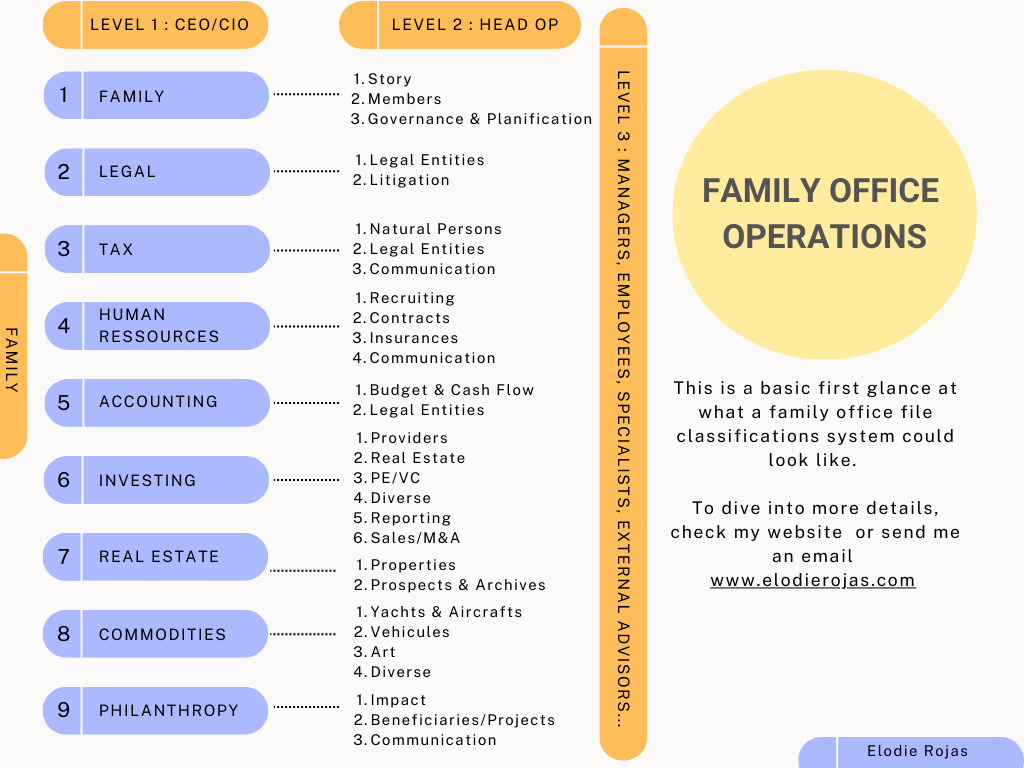
Of course, the complexity of the system depends on the volume of the assets. And of course, the numbers and the nature of the topics can change depending on the family and the evolution of the family office.
As a matter of fact, I am thinking about adding a 10th folder dedicated to risk management and technologies. And this is exactly the efficiency of the system: it stays agile, and is constantly evolving to match the needs of the family at all time.
On future posts and if I see an interest, I will dive into more details on each of the topics to show you how it looks at the lower levels (3 & 4).
What to avoid?
While building your own file classification system, you might face some difficulties or make mistakes. This is normal and we should embrace each of those difficulties as they show us a gap, and an opportunity for improvement.
However, here are a few things to keep in mind :
- Choose a method for naming files and folders at the beginning, and be consistent of it
- Never allow duplicates
- Make a difference between current and archived documents
- Write down all the protocols
- Manage closely who can access the system or parts of it
- Set up professional and automated back-ups
I hope you enjoyed this first post on the operational side of the family office.
Feel free to comment, share or contact me on the subject. I would love to hear from you and how others manage their operations!

 Elodie Rojas
Répondre à Keeping things simple in a complicated world – Elodie Rojas Annuler la réponse.